The Mystic Lamb
The Mystic Lamb: a polyptych in Ghent that has been stolen, split, hidden, faked and restored — and is still missing one panel.
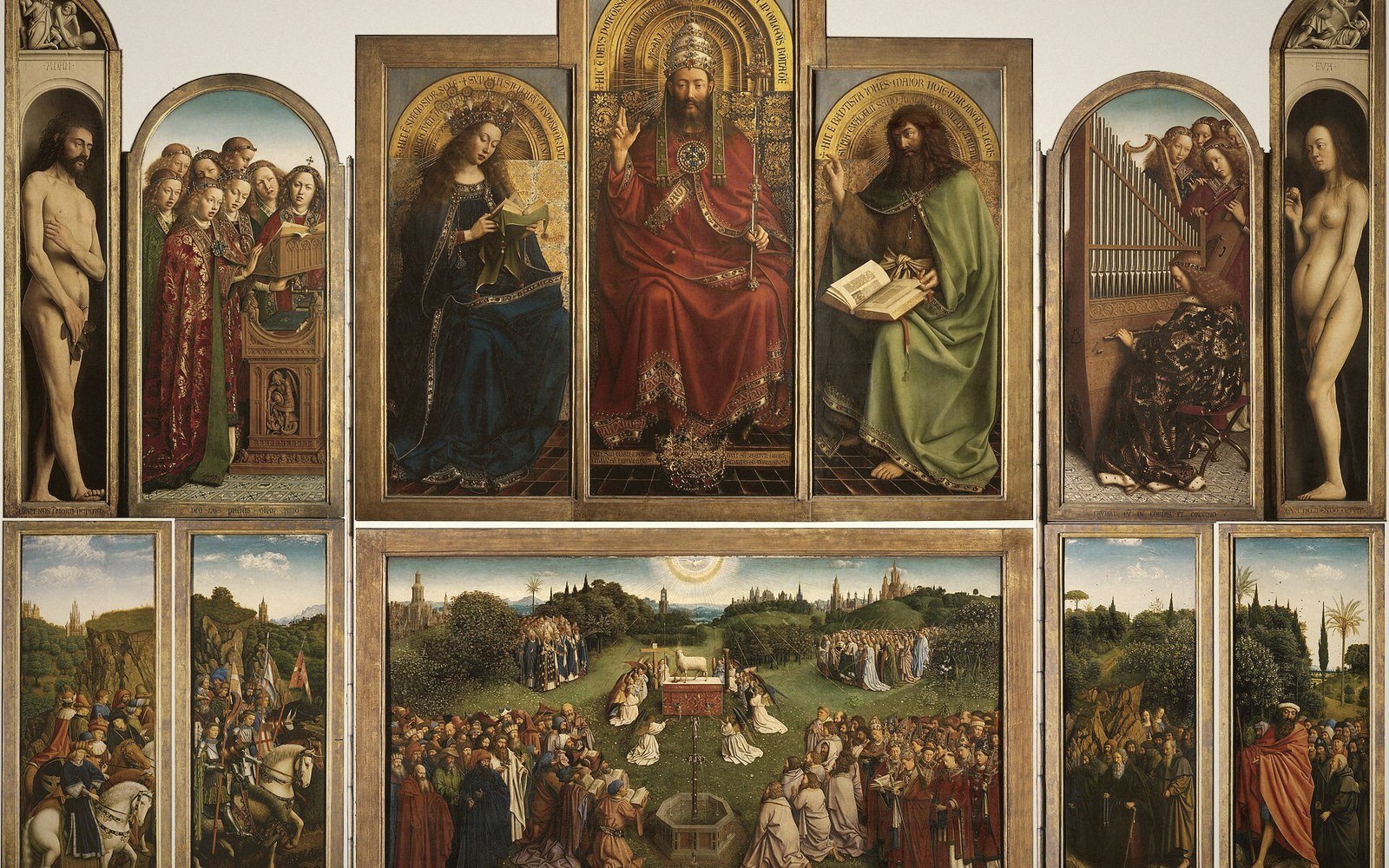
Twenty-four panels open, twelve closed. The lower outer panel in the frame is a copy made in the 1930s.
Photo: Lamgods open · Wikimedia Commons
The Adoration of the Mystic Lamb is a large hinged altarpiece, completed in 1432 and installed in the Cathedral of Saint Bavo in Ghent. It has twelve panels when closed, twenty-four when open. The painters named in a Latin inscription on the work itself are Hubert van Eyck, who apparently began it, and his younger brother Jan, who finished it. The inscription is not straightforwardly legible — its metre is awkward, its claims contested — and no signed work by Hubert survives for comparison. The extent of each brother's contribution remains a matter of active scholarly argument. What is not disputed is that the altarpiece as it stands is among the most technically ambitious paintings in the European tradition and was so recognised almost immediately after its completion.
The outer panels, visible when the wings are folded shut, show a grisaille Annunciation — grey-painted figures on grey stone niches, designed to pass as sculpture, and still startling in that illusion after nearly six centuries. The inner face, revealed when the wings are opened, organises itself over two registers. In the upper tier, God the Father (or Christ in Majesty, the identification is still debated) sits enthroned in crimson and gold, flanked by the Virgin and by John the Baptist, then by musician angels and, on the outer panels, Adam and Eve in naked, unheroic particularity — the first naturalistic nudes in Northern painting, self-conscious and heavy-footed in a way that reads as observation rather than ideal. Below, the altarpiece gives the work its common name: a vast meadow crowded with pilgrims, knights, hermits and angels converging on a white lamb standing on an altar, blood flowing from its chest into a chalice. The Just Judges panel, at the lower left of the lower register, is the one that currently hangs in its frame as a copy.
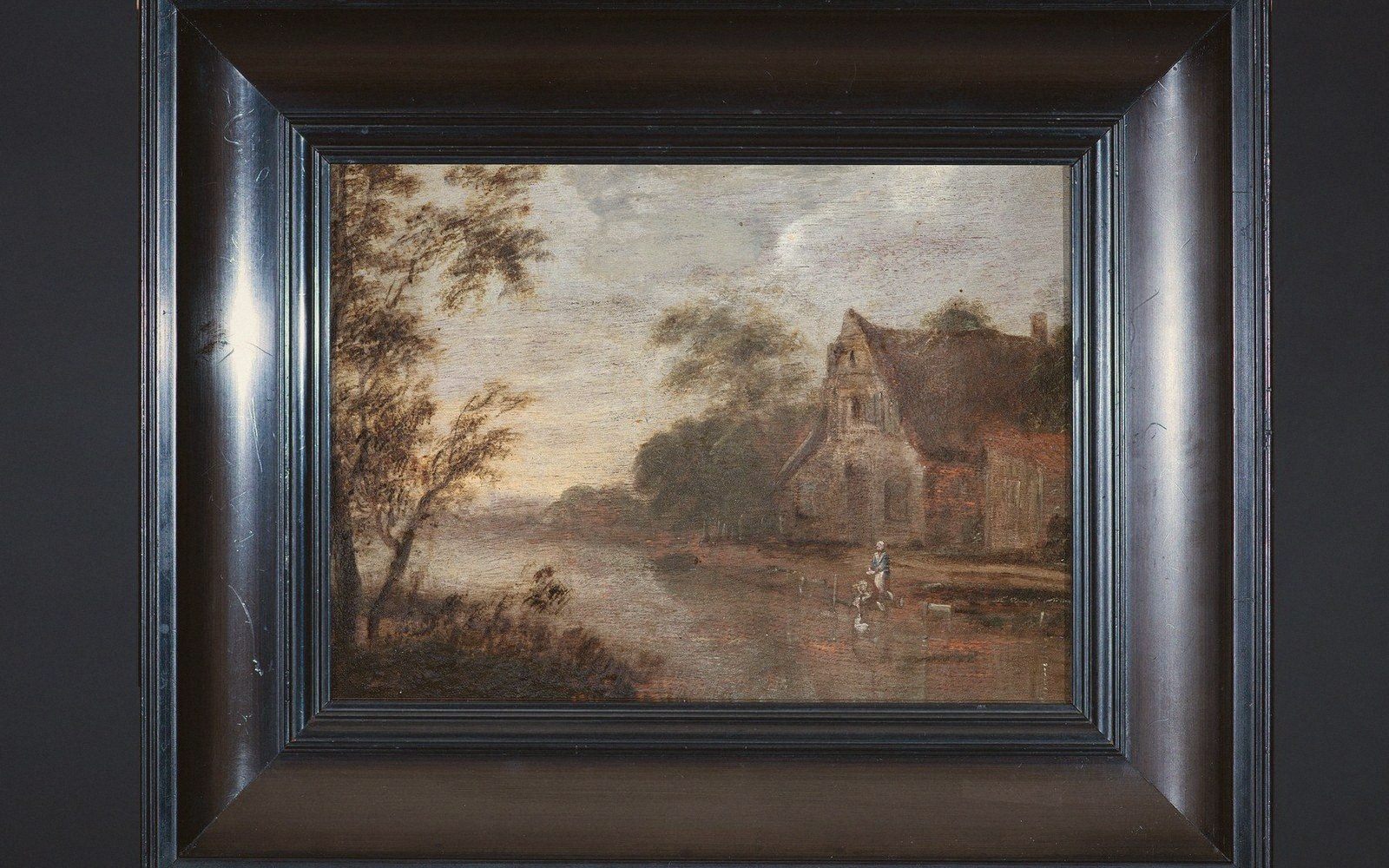
Raking light is the first examination made on any panel: it turns a flat surface into a topography of lifting, cupping and old fills.
Photo: Jan van Goyen – Country House by the Water – c. 1640–1650 – Oil on oak panel – Beatriz de Luna Art Collection · Wikimedia Commons
What was done to it
The altarpiece was moved during the French Revolution, then partially broken up under Napoleon's requisitions — several panels went to Paris, were returned after 1815, and were eventually bought by the King of Prussia, sending the six outer lower panels to Berlin. The Ghent cathedral retained the remainder. Reunification came only in 1920, as a condition written into the Treaty of Versailles: Germany surrendered the Berlin panels as reparation, and the altarpiece was whole again for the first time in a century. It did not stay that way.
In April 1934, the lower-left panel of the outer wings — a depiction of the Just Judges riding through a forest — was stolen overnight. A ransom demand followed, attributed to a man named Arsène Goedertier, who died shortly after without revealing where the panel was. A replacement was painted by the Belgian artist Jef Van der Veken and installed in the frame where it still sits. The original has never been found. At the time of the theft, the bishop of Ghent received letters claiming to know its location; those letters are archived, the location they implied was searched, and the panel was not there. Searches have continued at intervals across nine decades.
The Second World War brought a different threat. The altarpiece was evacuated south, eventually reaching the Château de Pau in southern France. German forces seized it in 1942 and transported it to Germany, intending it for Hitler's planned Führermuseum at Linz. It ended the war deep in the Altaussee salt mine in Austria, wrapped in the same conditions of low temperature and stable humidity that had, unintentionally, helped preserve it. It was among the objects recovered by the Monuments, Fine Arts and Archives section of the Allied forces in 1945 and returned to Ghent by September of that year.
What the cleaning changed
The most recent phase of examination and treatment ran from 2012 to 2020, conducted by the Royal Institute for Cultural Heritage in Brussels. It was not the first cleaning — a restoration campaign in the 1950s had already removed overpaint — but it was the most systematic, using macro X-ray fluorescence scanning and infrared reflectography to map the picture layer by layer before any intervention. What emerged altered the painting's appearance in ways that surprised even specialists.
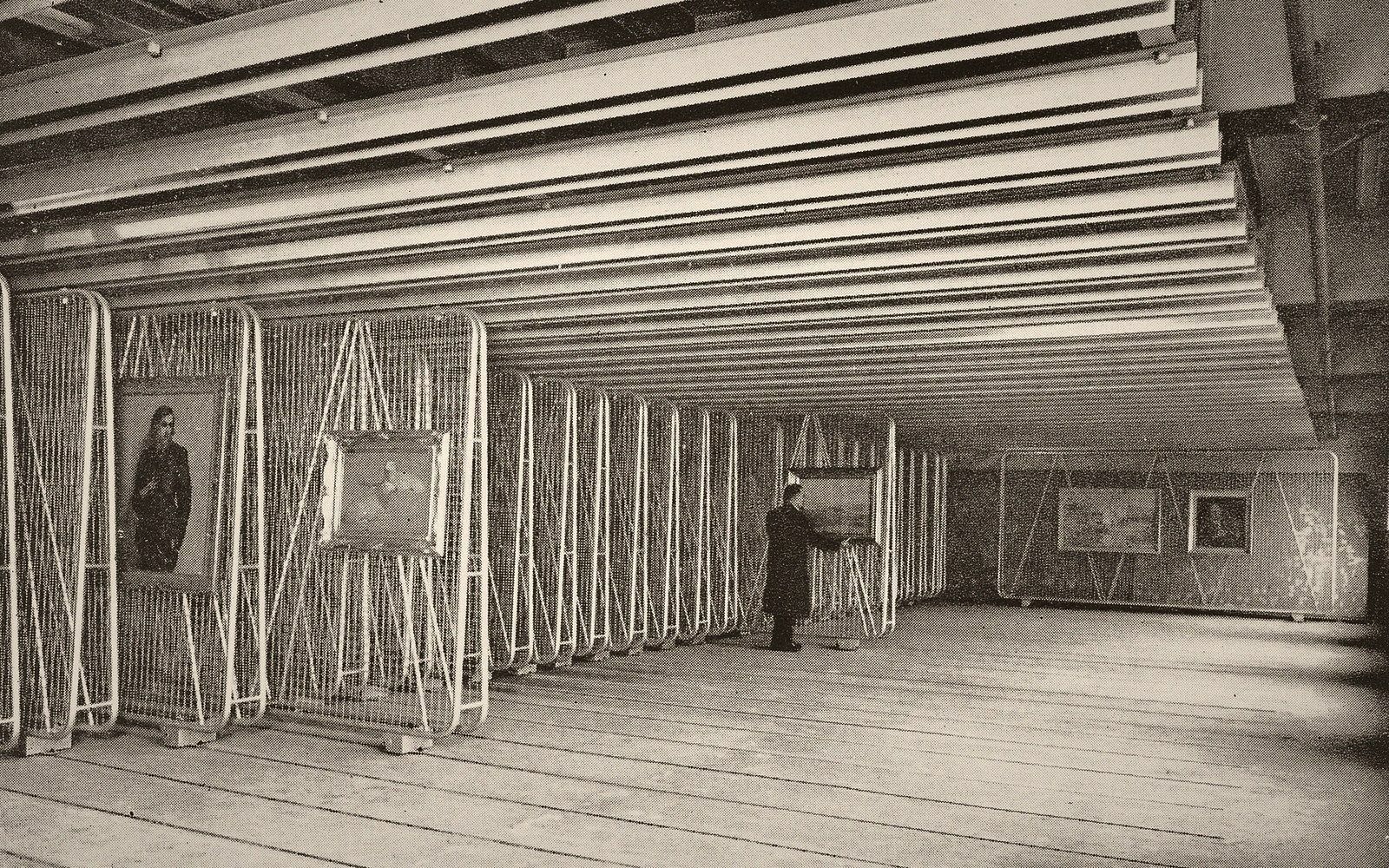
Most of a collection lives on racking like this. The room is designed around retrieval, not display.
Photo: Picture storage racks at the Walker Art Gallery, Liverpool. Wellcome M0015437 · Wikimedia Commons
The lamb's face was the most discussed. Earlier restoration had repainted the face in a convention of the time: wide-set, side-facing, almost bovine eyes. The scanning showed that underneath sat an entirely different head — the lamb of Jan van Eyck's original facing front, with large, eerily human eyes staring directly out of the altarpiece. That face, uncovered during treatment, transformed the central image. It is confrontational in a way the earlier version was not. The animal looks back with an intentness that sits uneasily between icon and naturalism, which is precisely where the rest of the painting lives.
Other changes were cumulative. The meadow recovered deeper greens and more differentiated foliage. The sky in the background gained distance. Carnations in the foreground, partially buried under old varnish, came back as individually rendered flowers. The spatial recession of the whole lower register became legible in a way it previously had not been, because layers of yellowed medium had been compressing it. The cleaning did not produce a brighter painting so much as a more dimensional one — figures and ground sorted themselves back into the relationship the painters intended.
The cleaned altarpiece now sits in a purpose-built viewing room installed within the cathedral's baptismal chapel. The framing and lighting are controlled. The Just Judges panel in its slot is Van der Veken's copy, made in the 1930s to a competent but clearly distinct standard; beside the newly cleaned original panels, the gap in quality is more obvious than before, which makes the absence of the original more present, not less.
What the theft of 1934 and the recoveries of 1945 both made clear is that this object's history is inseparable from the object itself. The Mystic Lamb has been a bargaining chip in diplomacy, a target for criminal ransom, a trophy of intended cultural annexation, and is now partly reconstructed from its own X-ray — a condition that is legible as new in the most literal sense. The panel still missing is a low outer wing of secular figures, not the theological heart of the thing, but its absence is documented, traced and still argued over in ways that have made the loss itself a permanent part of the altarpiece's meaning. An object this thoroughly tracked, copied, hidden and recovered accumulates a kind of parallel record. The Mystic Lamb is the painting in the frame and the history that followed it into and out of the frame over six centuries. Both are now part of what you look at.
Filed in Collections