Legible as new
The rule that repairs should look like repairs
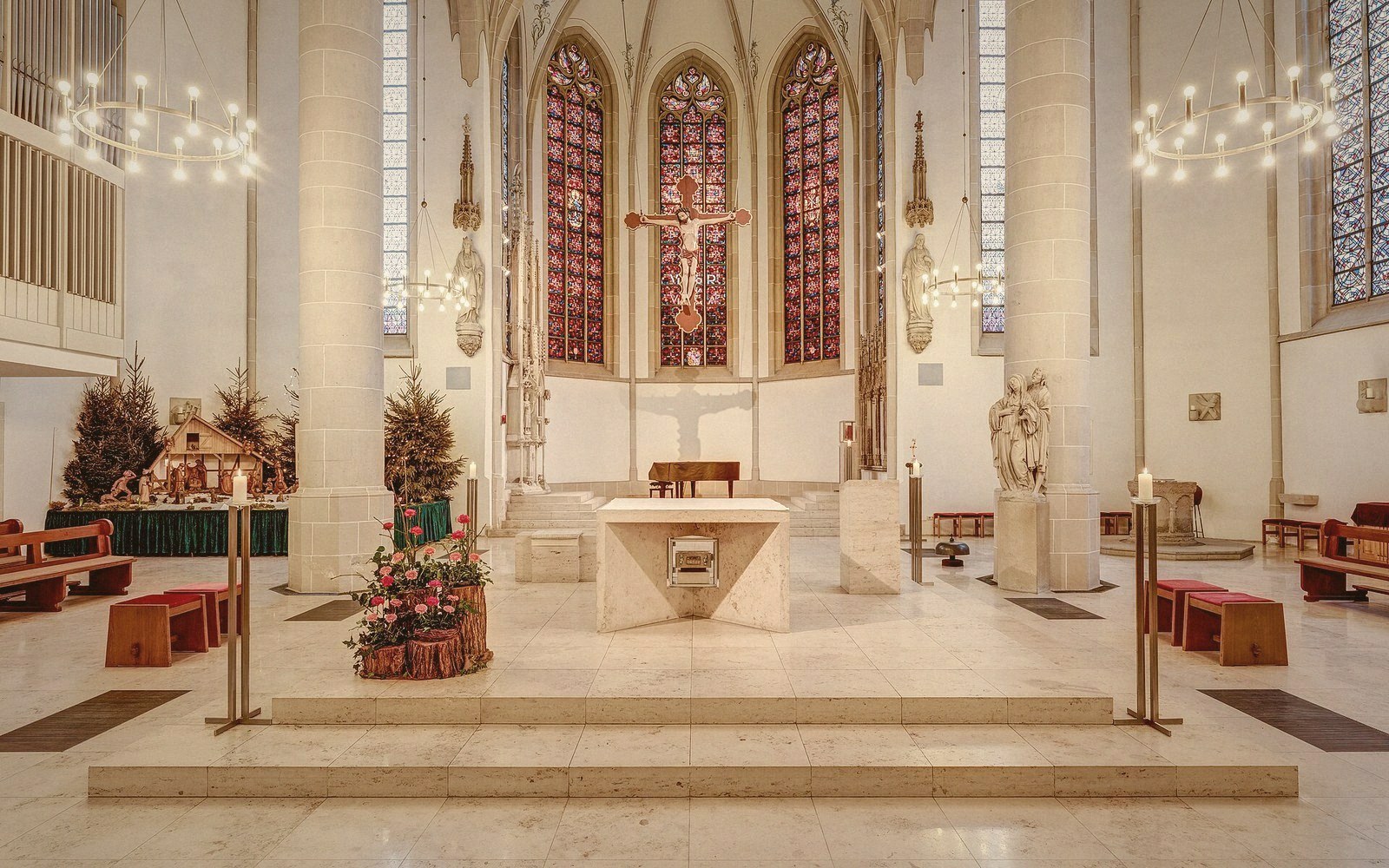
New work set into old fabric without imitation. The repair is meant to be read as a repair.
Photo: Dülmen, St.-Viktor-Kirche, Innenansicht, Altar -- 2018 -- 0552-6 · Wikimedia Commons
The principle is almost a century old, and it still provokes argument in every country that takes conservation seriously. A repair should be distinguishable from the original — not loudly, not aggressively, but enough that an informed eye can tell the difference. The old name for its opposite is stylistic restoration: putting back what was never there, blurring the record, making a building testify falsely to its own past.
The cleaner formulation belongs to the mid-twentieth century, when Italian conservation theory made it explicit: riconoscibile, recognisable as an intervention, without pretending to be the thing it stands beside. Cesare Brandi's 1963 Teoria del Restauro is the canonical text, though the thinking grew from decades of practice across bomb-damaged Italy and the slow accumulation of ideas at what is now the Istituto Centrale per il Restauro in Rome. The rule does not require ugliness. It requires honesty.
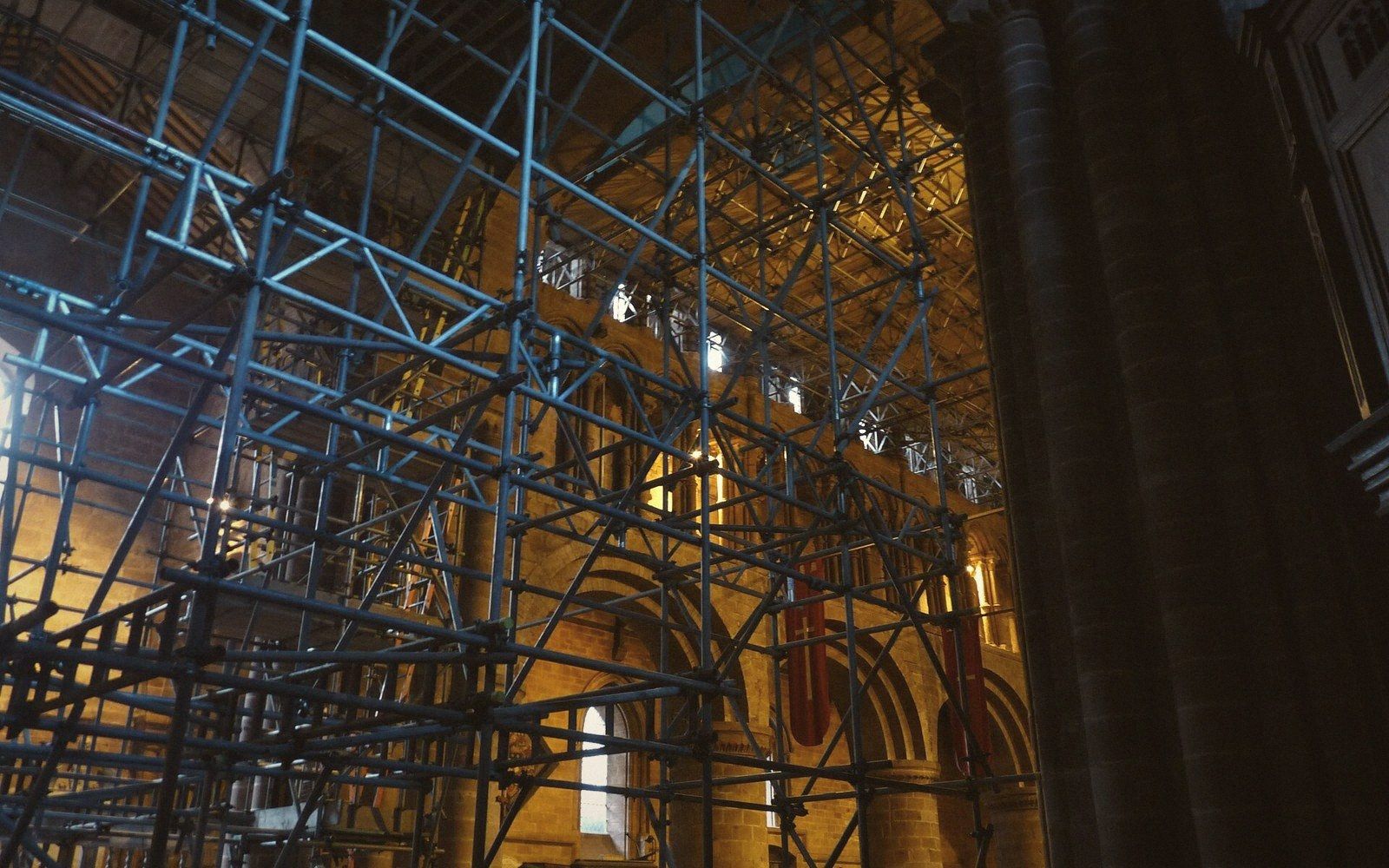
Scaffolding is designed to stand free of the fabric. Nothing structural may lean on the building being repaired.
Photo: St John the Baptist Parish Church, Chester - crossing and east end of nave with scaffolding from north · Wikimedia Commons
In practice it means that a replaced stone reads slightly differently from its neighbours — not in shape or proportion, which should match, but in surface weathering or finish. A missing fresco section is filled with a neutral tone that sits behind the original rather than competing with it, often using the technique called tratteggio: fine parallel hatching in a toning colour, visible close up, coherent with the original from a distance. Mortar in a repaired wall is matched in texture but distinguished in colour, or set slightly back from the face of the stone. The information is preserved in the fabric: that this is the original, and that is the repair.
Where it has been ignored
The principle is honoured more often in theory than in stone. The most consistent offender is not negligence but confidence — the conviction, common in the nineteenth century and revived in various nationalistic building programmes since, that the restorer knows exactly what the original looked like and has a duty to reinstate it. Viollet-le-Duc left buildings in France that are better understood as his own work than as medieval record. Carcassonne is the most visited example: its distinctive double-conical roofline on the towers was his decision, contested by scholars even in his lifetime, and there is no material trace on the existing structure to distinguish his masonry from the medieval. The building reads as whole. It is not.
The same logic ran through the reconstruction of Warsaw's Old Town after 1945, where deliberate policy — and genuine popular will — produced a city centre rebuilt to Canaletto's paintings and eighteenth-century survey drawings. The result is a Unesco World Heritage Site valued precisely for what it is: not a surviving medieval city but a post-war act of collective memory in brick and plaster. Warsaw is the clearest case of a society choosing wholeness over legibility and doing so knowingly, which makes it categorically different from a restorer who simply oversteps.
The more damaging pattern is the one that happens by default, without debate: a Victorian church repointed in hard grey cement, the original lime joints ground out and the new work finished flush and uniform, making thirteenth-century stonework read as recently built. No record was falsified on purpose. The fabric was simply treated as a surface rather than as a document. The reversibility argument cuts the same way: cement cannot be removed without damaging the stone beneath, so the decision is permanent, and the information is gone.
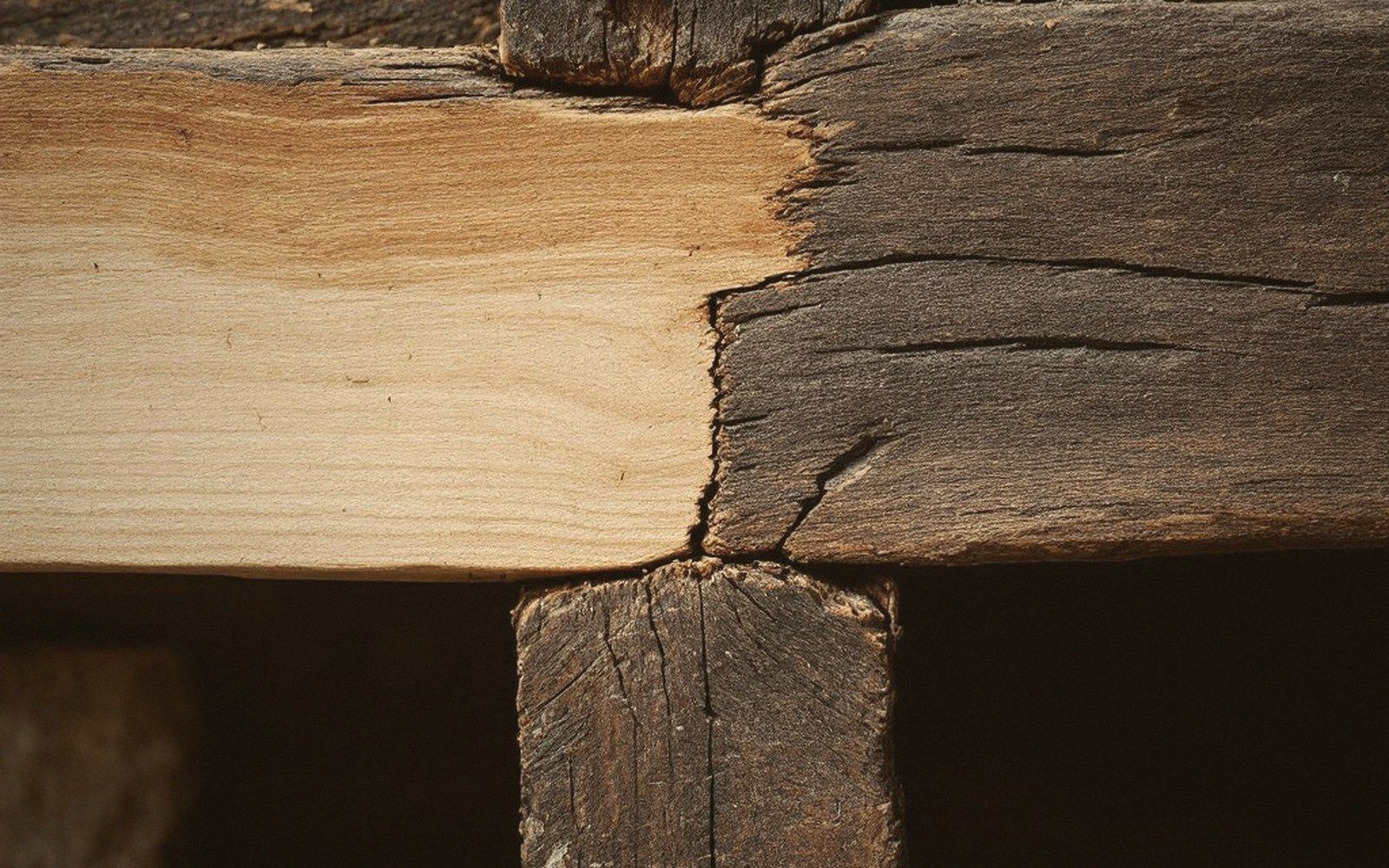
A scarf joint lets new timber into an old beam instead of replacing it. The new wood is left pale so the repair stays readable.
What distinguishes good practice
The strongest modern conservation tends to be frank in one register while restrained in another. At the Colosseum, interventions since the 1990s have used a slightly lighter travertine in sections where structural consolidation required new stone — the match is close enough that the building remains coherent as a whole, but the new work is recorded and photographed, and a specialist can read the phases. At Hagia Sophia, where the status of the building has made conservation politically complicated, the layering of Byzantine mosaic, Ottoman plaster, Fossati-era restoration and more recent cleaning is itself a historical record — one that legibility-based practice exists to preserve rather than paper over.
The principle is not that every repair should shout. It is that every repair should be honest, and that the building's surface should remain a source of evidence rather than a performance. Heritage that reads as seamlessly original is often heritage that has been quietly rewritten.
Filed in Fabric