Panel and canvas
Two surfaces, two fates
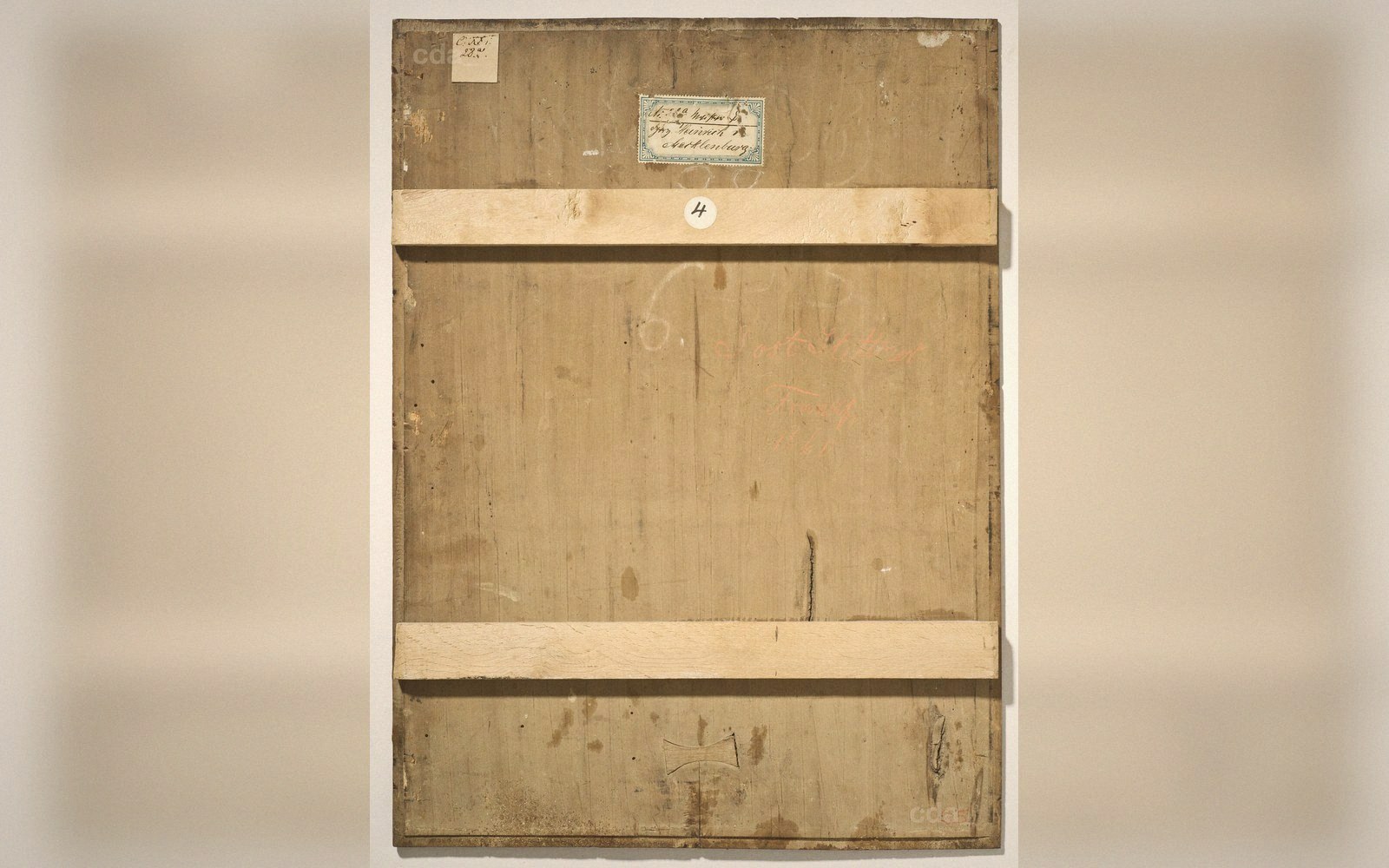
The reverse carries the evidence: battens, labels, inventory marks, and the grain that decides how the panel moves.
Photo: Heinrich V, Duke of Mecklenburg, called the Peaceful (DE KSVC M025 2013 Reverse) · Wikimedia Commons
Wood and linen are both organic materials, and both age badly in the wrong conditions — but they age in opposite directions, and that difference is responsible for a good part of what conservators spend their working lives managing.
A painting on panel is made on a rigid, cellular structure that responds to moisture. Wood expands across the grain when humidity rises and contracts when the air dries out. It does this seasonally, daily, sometimes hourly, and it does it whether the paint layer likes it or not. The paint, which became inflexible decades after it was laid down, does not expand and contract at the same rate as the wood beneath it. The result, over centuries, is a network of cracks running largely along the grain — the characteristic craquelure of early panel painting — and in worse cases, flaking, cleavage, and active loss. Thick, densely built-up passages, gilded grounds, and the particular brittleness of egg tempera all make the problem worse.
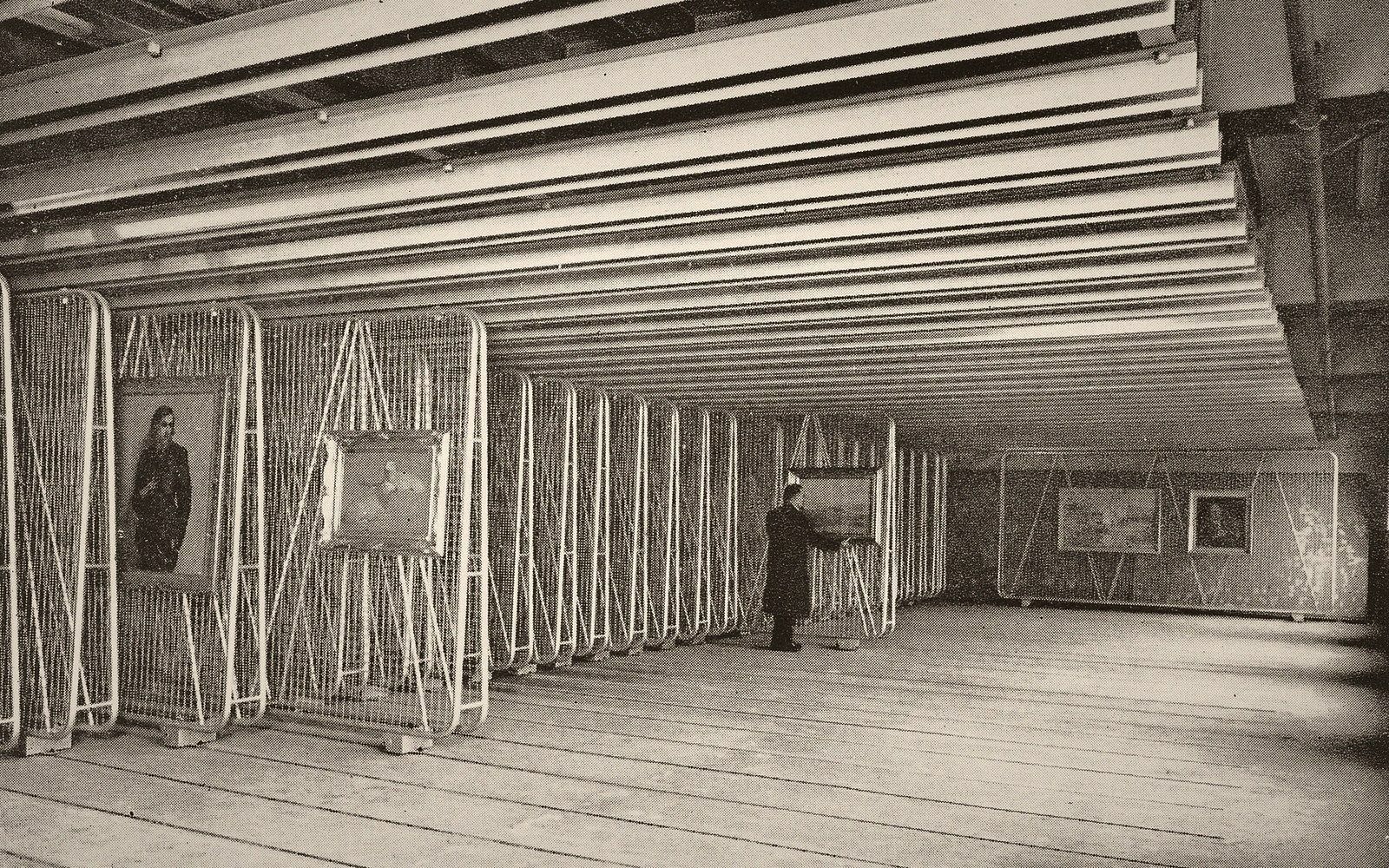
Most of a collection lives on racking like this. The room is designed around retrieval, not display.
Photo: Picture storage racks at the Walker Art Gallery, Liverpool. Wellcome M0015437 · Wikimedia Commons
A painting on canvas works differently. The linen or hemp support is woven, and it sags rather than cracks. The ground and paint film — most commonly oil on a chalk or lead white preparation — are more flexible than tempera on gesso, and they move with the textile to a degree. But canvas responds to humidity too, and it responds faster than wood: it tightens and slackens with changes in relative humidity, and it does so across the whole surface at once, stressing the paint film in the process. Over time the canvas weakens, tears develop along old fold lines, and the support can no longer hold its shape. Old age on canvas is more often about structural collapse than about cracking.
Consequences for movement
The practical difference matters the moment a work leaves its wall. Panel paintings are fragile to travel in a way that is almost impossible to fully mitigate. Every change in climate the work passes through — loading bay, truck, hold, customs shed, gallery — is another cycle of expansion and contraction. Loan agreements for major early panels, Flemish and Italian primitives especially, now routinely specify environmental conditions in transit, sometimes down to two or three degrees of relative humidity tolerance. Museums turn down loan requests on these grounds, and the refusals are not timidity: they are reading the state of the object.
Canvas paintings travel better, all else being equal, but all else is rarely equal. A canvas that has been lined — a second canvas adhered to the back to stabilise a weakened original — may carry the additional stress of two textiles responding at slightly different rates. Restretching an old canvas risks tearing along weakened threads. And any painting with a heavy impasto, the thick raised paint surface common in seventeenth-century Dutch and Flemish oils, is vulnerable to vibration regardless of support.
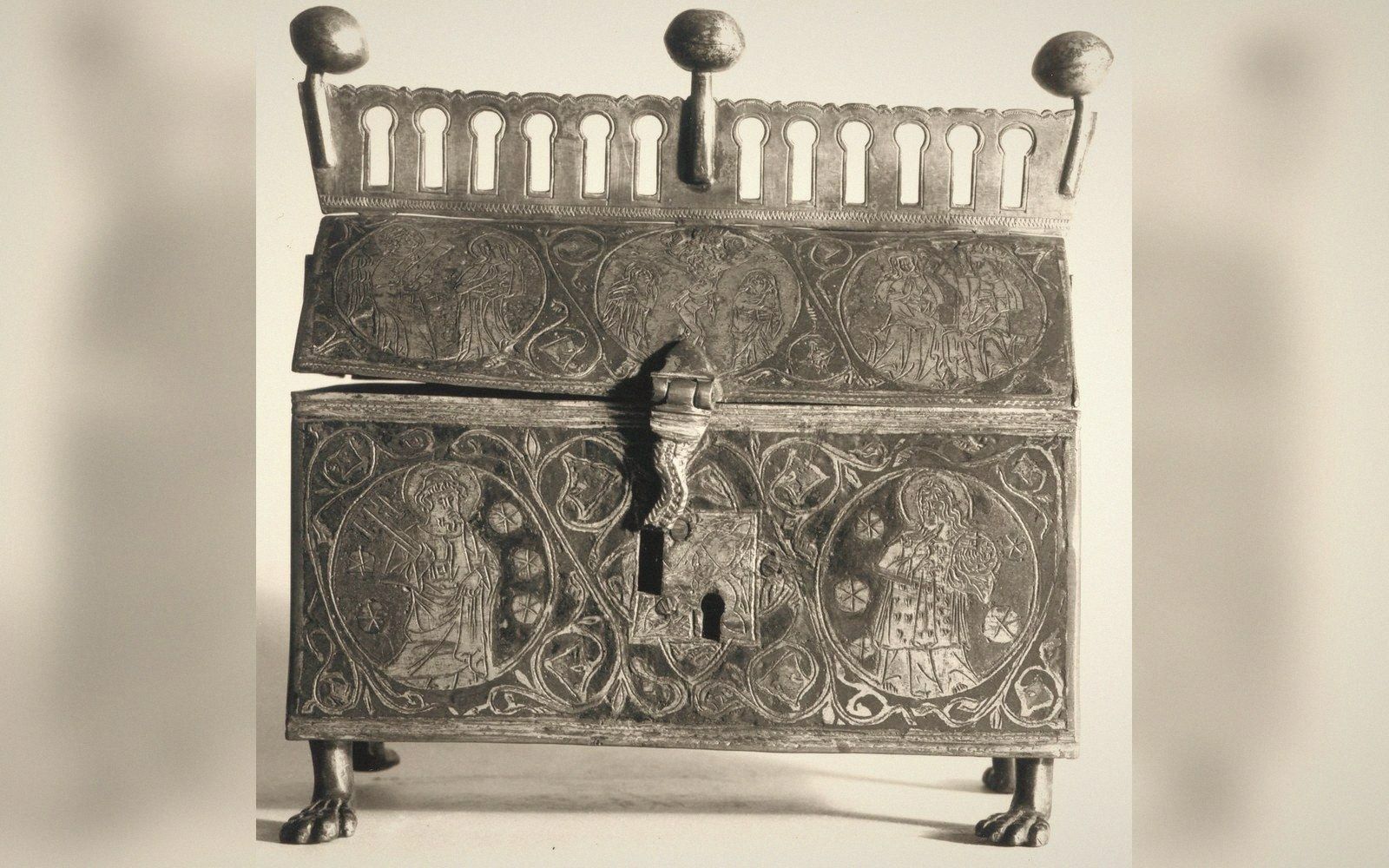
A treasury groups by material rather than subject, which is how a casket and a chalice end up in the same case.
Photo: Reliquary box · Wikimedia Commons
The question of which surface a painter chose was often practical rather than aesthetic. Panel dominated in Northern Europe through most of the fifteenth century; canvas overtook it in Italy, Venice in particular, from the mid-sixteenth century onward, partly because large canvases were lighter and cheaper to transport by sea. By the seventeenth century, canvas was the standard for most work above a small scale almost everywhere. Panel survived in altarpieces, in devotional miniatures, and in the Northern tradition long enough to give Rubens and Rembrandt both — the latter using panel for many of his self-portraits and small history pictures into the 1640s and 1650s.
The object in front of you in a gallery carries its history on its surface in both cases. Cleaned panel paintings often show their crack patterns clearly across the grain; a relining on the back of a canvas is a signature of past crisis. Neither is a failure of the work. Both are evidence of what the material has been doing for four hundred years, responding to every room it has been in, every journey it has made, every radiator someone placed too close to the wall.
Filed in Collections