The procession
A route walked on the same day each year encodes something older than the feast it celebrates.
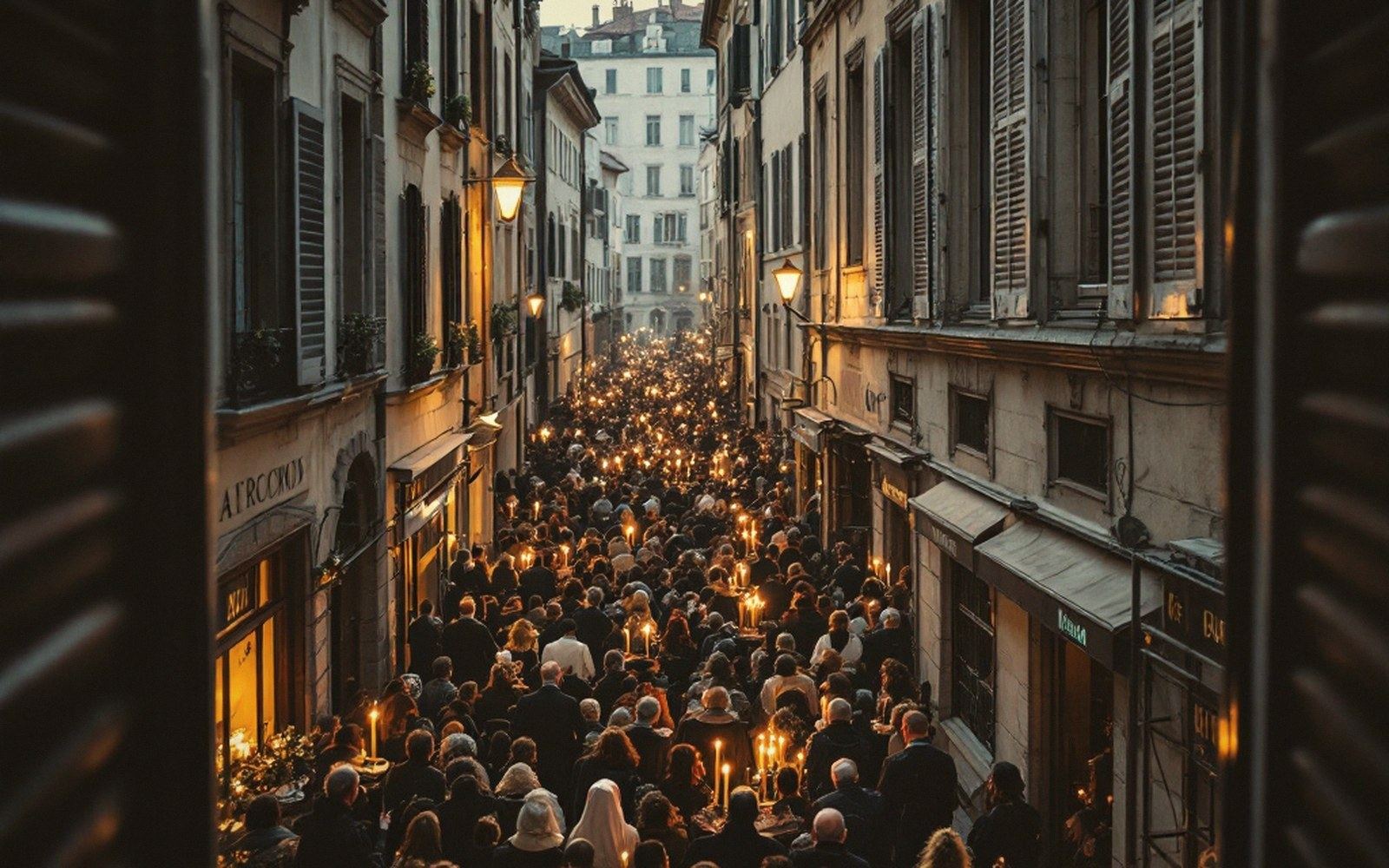
The route is usually older than the reason given for walking it.
The Route Comes First
The procession is one of the oldest acts of collective memory in Europe, and the route almost always predates the story told to explain it. Walk the same path once and it means nothing. Walk it every year for two centuries and it becomes the thing itself — the boundary made visible, the community rehearsed.
Historians of popular religion have long noted that Christian feast-day processions were frequently grafted onto paths that already existed: old parish boundaries, cattle tracks, the outer edges of a market's customary reach. In southern Italy and in the Basque Country the routes of summer processions follow ridgelines that fieldwork suggests were in use long before the church calendar set the date. The feast is the occasion; the route is the archive.
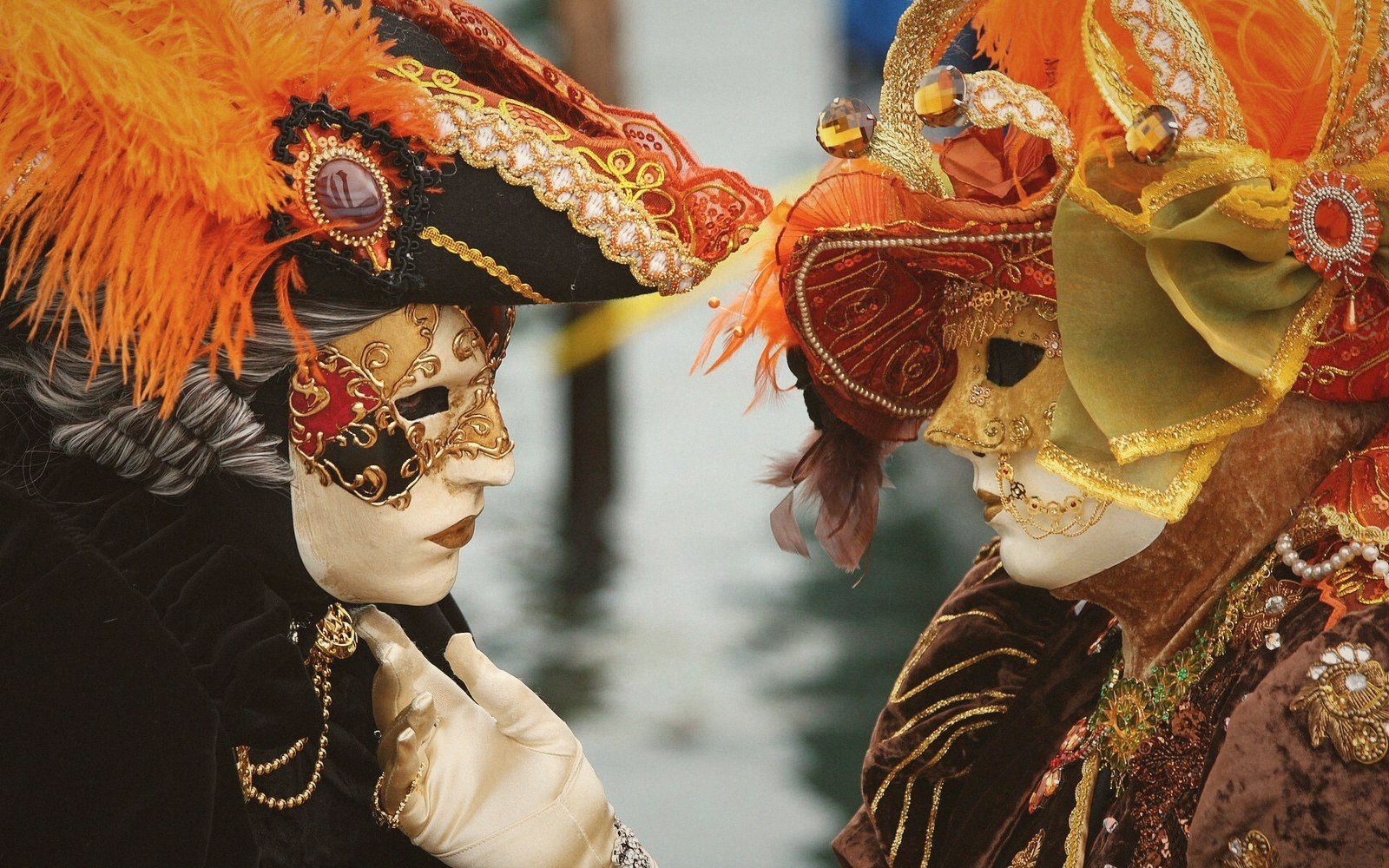
Photographed away from the crowd against a plain wall, the costume reads as an object again.
Photo: Venice Carnival - Masked Lovers (2010) · Wikimedia Commons
The objects carried matter separately. Statues, reliquaries, gilded canopies, painted banners — each has its own provenance and its own guild or confraternity (brotherhood) responsible for carrying and maintaining it. In Seville, the pasos — platform floats bearing carved and painted figures — are stored in the church basements for the rest of the year; in that context, the building's function is essentially the storage of processional hardware. Some of these objects are of extraordinary age and quality, made in the sixteenth and seventeenth centuries by craftsmen whose names are now known. Others are early-twentieth-century replacements of pieces too fragile to carry, or replicas made when the original was looted, lost or sold. The procession makes no distinction; carried in the right position, on the right day, the replacement is received as the thing itself.
The Body that Walks
What makes a procession different from a parade is obligation. Most processions still carry — even faintly — the sense that participation is required: by guild membership, by neighbourhood, by having received a favour attributed to the object being carried. The penitent's robe in Andalucía, the candle held in silence in a Breton pardon (a pilgrimage procession seeking indulgence), the branch cut and carried in certain Alpine spring rites — all involve the body doing something prescribed, not chosen. That prescribed quality is precisely what the calendar governs: remove the date and the obligation dissolves.
In practice, numbers fluctuate. Population movement, secularisation and the reshaping of town centres by mid-twentieth-century planning have all shortened routes and thinned crowds. What is striking is how rarely a procession dies entirely. It contracts to a core of families, a single street, a handful of objects still carried; then in a generation it recovers, sometimes expanding again when a neighbourhood asserts its identity against broader homogenisation. The revival is not always a straightforward continuity — sometimes it is a reconstitution from photographs, archive records and the memories of the oldest participants — but it produces something that functions as the same event.
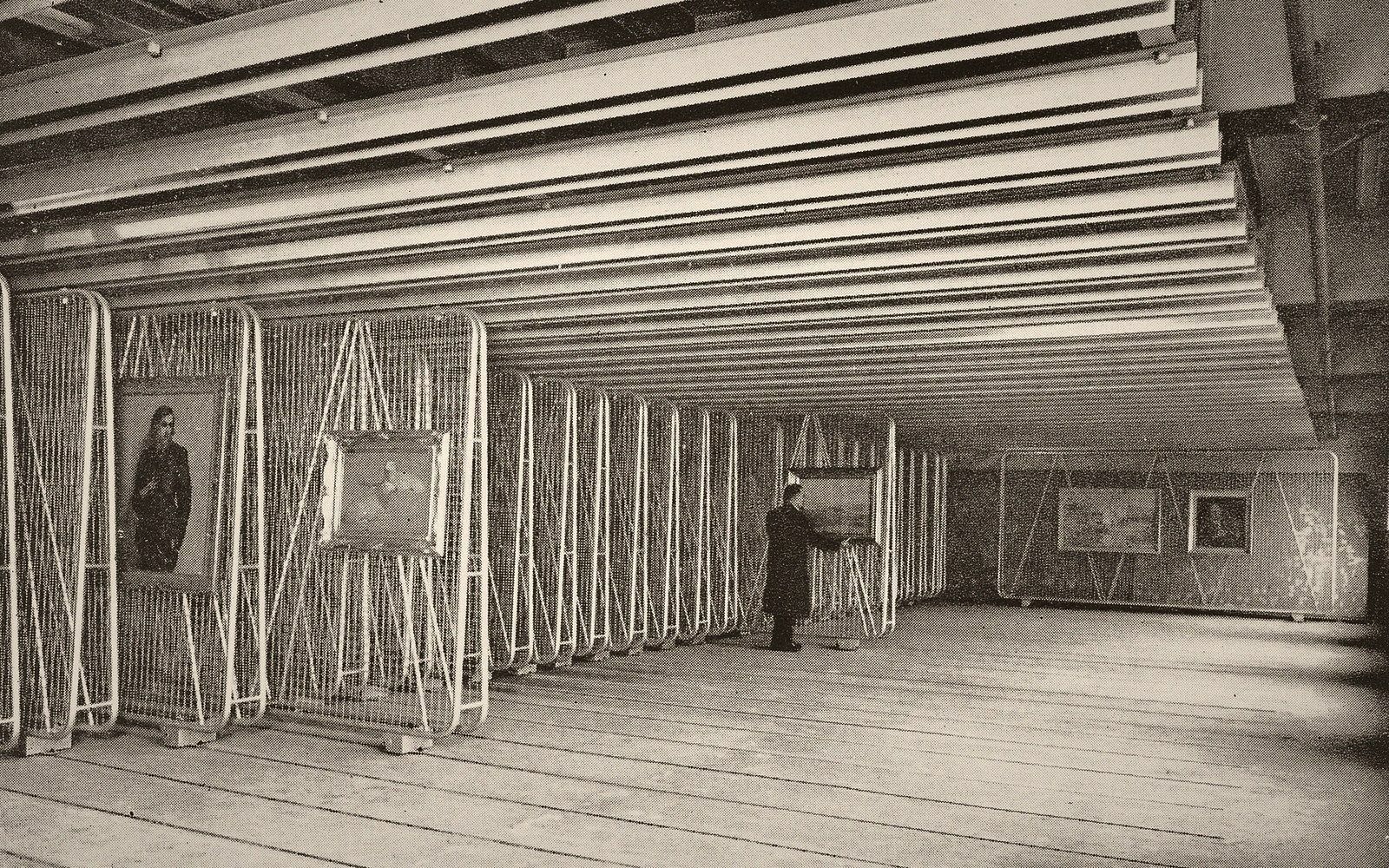
Most of a collection lives on racking like this. The room is designed around retrieval, not display.
Photo: Picture storage racks at the Walker Art Gallery, Liverpool. Wellcome M0015437 · Wikimedia Commons
What Survives and How
The material culture of processions is among the least studied categories of heritage, partly because it moves. Objects fixed in a church or a collection can be catalogued; an object brought out once a year, handled by dozens of people, repaired informally by the confraternity's own members, and stored in a sacristy cupboard, remains largely outside the survey. Some pieces are now documented — Flemish processional reliquaries have entered major collections; the canopied floats of Corpus Christi in Toledo and Cusco are now treated as heritage objects in their own right. But the greater number of banners, staffs, crowns, ex-votos and model boats nailed to interior walls remain unrecorded.
What remains constant is the structure: a fixed day, a fixed route, objects of fixed identity carried in a fixed order. The meaning given to that structure is renegotiated by each generation, which is the usual condition of living heritage — not the preservation of a meaning but the preservation of a form that people refill.
Filed in Observance